SYDNY
SYDNEY
HomeGeophysicsResistividad eléctrica / SEV (sondeo vertical)

Electrical Resistivity / VES (Vertical Electrical Sounding) in Sydney

Rigorous testing. Clear reporting.

LEARN MORE

We were called to a site in the Botany Bay industrial area where a developer wanted to build a 4-storey warehouse on what looked like flat, solid ground. The boreholes showed fill, but nobody knew how deep the old landfill extended. That is where electrical resistivity (VES) became the only practical tool. Instead of drilling blind across 3 hectares, we ran six Vertical Electrical Sounding profiles and mapped the waste boundary within two days. The client saved weeks of drilling and got a reliable 3D resistivity model that guided the excavation plan. In our experience, this is one of the most overlooked techniques for brownfield sites in Sydney, where former industrial zones hide unpredictable buried debris.
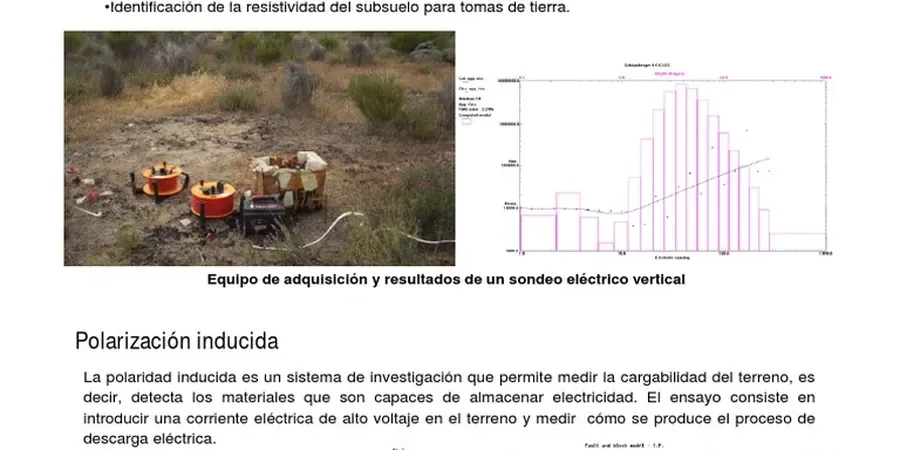
Illustrative image of Electrical resistivity / VES (Vertical Electrical Sounding) in Sydney
A single VES profile can replace 10 boreholes for mapping bedrock depth across a large Sydney site. Non-invasive, fast, and surprisingly accurate.

Our service areas

Scope of work

What sets electrical resistivity apart from conventional drilling is the ability to cover large areas without disturbing the ground. In Sydney we frequently work on sites underlain by Hawkesbury Sandstone where fractures control groundwater flow. A VES survey picks up those water-bearing zones clearly. We run multi-electrode arrays with 48 to 72 takeouts and use both Wenner and Schlumberger configurations depending on target depth. The data is inverted in Res2DInv software to produce resistivity sections down to 30–40 metres. For shallow contamination mapping, we combine this with georradar GPR to correlate electrical anomalies with buried objects. The field crew logs each electrode position with RTK GPS so the model aligns with the site grid. It is a non-invasive, fast method that complements our borehole program without replacing it.
Technical reference — Sydney

Area-specific notes

The most common mistake we see in Sydney is treating VES as a standalone solution without correlating the results with at least one borehole or test pit. Resistivity values can be ambiguous — a high resistivity zone could be dry sandstone or a buried concrete slab. We once saw a consultant interpret a 500 ohm·m anomaly as bedrock, but it turned out to be a disused septic tank. That error forced a redesign of the foundation layout. Always ground-truth the geophysics with a few strategically placed boreholes or CPT tests. It saves time and avoids costly surprises during excavation.

Need a geotechnical assessment?

Reply within 24h.

Email: contact@geotechnicalengineering1.co

Standards used

AS 1726:2017 Geotechnical site investigations, AS 1289 (DC resistivity for geotechnical investigations), Environmental Protection Authority (NSW) guidelines for contaminated land assessment

Technical parameters

ParameterTypical value
Array typeWenner / Schlumberger / Dipole-Dipole
Number of electrodes48 to 72
Depth of investigationUp to 40 m (typical)
Inversion softwareRes2DInv / Res3DInv
PositioningRTK GPS (±2 cm)
Typical profile length120–200 m
Resistivity range resolved1 to 10,000 ohm·m

Quick answers

How deep can electrical resistivity detect in Sydney's Hawkesbury Sandstone?

With a 72-electrode array and 5 m spacing, we typically reach 30–40 m depth in resistive sandstone. In conductive clay or saline groundwater, the depth reduces to around 15–20 m. We always run a field calibration beforehand to confirm the signal-to-noise ratio.

What is the difference between ERT and VES?

ERT produces a 2D cross-section of resistivity along a line, showing lateral variations in geology. VES gives a 1D depth profile at a single point, ideal for layered models like sand over clay. We usually recommend ERT for site-wide mapping and VES for targeted depth sounding.

Can electrical resistivity detect groundwater contamination?

Yes, because contaminants like leachate or hydrocarbons change the electrical conductivity of the pore fluid. A plume of saline leachate appears as a low-resistivity anomaly (typically <10 ohm·m). We have successfully mapped contamination plumes at former service stations in Sydney using ERT with borehole validation.

Do you need to close roads or get traffic management for a VES survey in Sydney?

Not usually. We use lightweight cables that can be laid along footpaths or medians. For surveys on busy roads like Parramatta Road, we coordinate with the local council and set up temporary lane closures during off-peak hours. The actual measurement takes about 45 minutes per profile.

How much does a typical VES survey cost in Sydney?

For a standard 200-metre profile with 48 electrodes and 2D inversion, the cost ranges between AU$910 and AU$1,590 depending on site access and data density. We provide a fixed-price quote after a site walkover. Additional profiles or deeper arrays increase the cost proportionally.

Location and service area

We serve projects across Sydney and its metropolitan area.

View larger map

Watch how it works