SYDNY
SYDNEY
HomeSlopes & WallsMSE Wall Design in Sydney | Reinforced Soil Engineering

MSE Wall Design in Sydney | Reinforced Soil Engineering

Rigorous testing. Clear reporting.

LEARN MORE

Sydney's coastal humidity and summer rainfall exceeding 1,200 mm annually create conditions that directly influence reinforced soil behavior. Moisture fluctuations can reduce shear strength in the backfill and accelerate corrosion in steel strips. For any MSE wall design in Sydney, the geotechnical model must account for perched water tables common in areas like the Cumberland Plain. That means drainage design is not optional. We integrate permeability laboratory tests to quantify flow rates before selecting reinforcement layout and facing type. Every design starts with a site-specific soil characterization, not textbook assumptions.
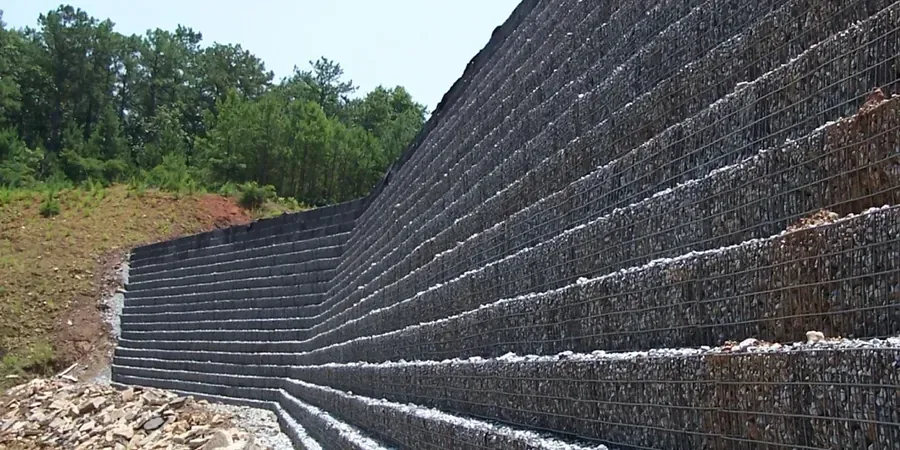
Illustrative image of MSE (Mechanically Stabilized Earth) wall design in Sydney
Moisture fluctuations in Sydney's clay fills can drop shear strength by 40%, making drainage design a non-negotiable part of any MSE wall.

Our service areas

Scope of work

A recent retaining wall project near Parramatta required a 9 m high MSE structure on a site with 4 m of fill over residual clay. The fill had variable compaction and unknown organic content. We ran Proctor compaction tests and Atterberg limits on every 500 m³ zone. The design used galvanized steel strips with a design life of 75 years per AS 4678. Key parameters included cohesion of 5 kPa for the backfill and a friction angle of 34 degrees. We also verified internal stability against sliding and overturning. The geogrid layers were spaced at 0.6 m with a maximum tensile load of 65 kN/m. The facing panels were precast concrete with weep holes and a geotextile filter.
  • Allowable bearing pressure of 150 kPa under the footing
  • Global factor of safety > 1.5 for external stability
  • Pullout resistance verified with site-specific pullout tests
This approach avoids the common pitfall of using generic reinforcement stiffness values that don't match the actual fill.
Technical reference — Sydney

Area-specific notes

The most frequent error we see in Sydney MSE projects is ignoring the long-term settlement of the retained fill. Developers often assume the fill is fully consolidated after a few years. But residual clays in the Hawkesbury Sandstone region can undergo creep settlement for decades. That ongoing movement changes the load distribution on the reinforcement. Without a settlement analysis using consolidation test data, the wall can develop excessive deflection or even bulging. Another common mistake is using a uniform drainage blanket when the site has variable permeability layers. That leads to water buildup behind the panels and increased lateral pressure. Both problems are avoidable with proper site investigation and a design that treats the wall as a soil-structure system, not a simple gravity block.

Need a geotechnical assessment?

Reply within 24h.

Email: contact@geotechnicalengineering1.co

Standards used

AS 4678:2002 Earth-retaining structures, AS 1726:2017 Geotechnical site investigations, AS/NZS 1170.4:2007 Structural design actions – Earthquake actions, FHWA-NHI-00-043 Mechanically Stabilized Earth Walls

Technical parameters

ParameterTypical value
Design codeAS 4678:2002 + Amendment 1
Backfill friction angle (design)32-36 degrees
Cohesion of retained fill0-10 kPa
Reinforcement typeGalvanized steel strip or geogrid
Maximum reinforcement spacing0.6 m vertical
Allowable bearing pressure under footing150-200 kPa
Seismic acceleration coefficient (Sydney)0.08 g (AS/NZS 1170.4)
Design life75 years (permanent structure)

Quick answers

What is the difference between an MSE wall and a conventional reinforced concrete retaining wall?

An MSE wall uses soil as the primary structural material, reinforced with strips or geogrids embedded in the backfill. The facing is usually precast concrete panels or wrapped geotextile. A conventional reinforced concrete wall relies on a cantilever or gravity section of cast-in-place concrete. MSE walls are generally more economical for heights above 3 m and tolerate differential settlement better because the soil mass deforms without cracking.

How much does MSE wall design cost for a typical Sydney project?

The geotechnical design fee for an MSE wall in Sydney typically ranges between AU$1.910 and AU$7.660 depending on wall height, site complexity, and the amount of laboratory testing required. A simple 4 m wall on a flat site with clean fill might be at the lower end, while a 10 m wall on a sloping site with variable soil layers will reach the upper range. The quote includes stability analysis, reinforcement layout, and construction specifications.

What soil conditions in Sydney make MSE walls unsuitable?

MSE walls are not recommended on very soft clays with undrained shear strength below 20 kPa, or on sites with high groundwater that cannot be drained effectively. In Sydney, areas underlain by saturated alluvial deposits near the Parramatta River or Botany Bay may require ground improvement before an MSE wall can be used. Highly corrosive soils with a pH below 5.0 also need special reinforcement coatings or stainless steel strips.

Location and service area

We serve projects across Sydney and its metropolitan area.

View larger map