SYDNY
SYDNEY
HomeIn-Situ TestingEnsayo Presiómetro de Ménard

Ménard Pressuremeter Test (PMT) in Sydney

Rigorous testing. Clear reporting.

LEARN MORE

We were called in on a site near the Sydney CBD where a 15-storey tower was planned over the Hawkesbury Sandstone. The structural engineer needed reliable deformation modulus values for the raft foundation design, not just SPT blow counts. Running a Ménard pressuremeter test (PMT) in the boreholes gave us direct measurements of the Menard modulus (EM) and limit pressure (pL) at 1.5 m intervals, which we then used to calibrate the settlement analysis. That job made clear why the pressuremeter is the preferred tool for stiff Sydney soils and rock — it captures the stress-strain response under controlled radial loading, something a standard SPT cannot do. For projects requiring a more continuous profile of shear wave velocity, we often combine PMT with a MASW survey to cross-check dynamic and static stiffness.
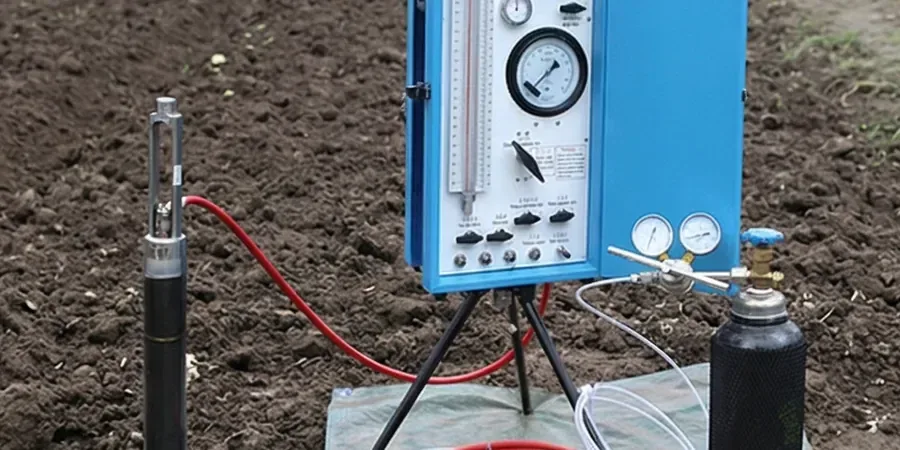
Illustrative image of Ménard pressuremeter test (PMT) in Sydney
In Sydney's Hawkesbury Sandstone, the Ménard pressuremeter often yields EM values exceeding 200 MPa, enabling raft foundations that save weeks of excavation.

Our service areas

Scope of work

What we repeatedly observe in Sydney is that the pressuremeter test delivers the most representative stiffness values for design because it loads the soil laterally in situ, preserving the natural fabric and stress history. We use a Ménard-type probe with three measuring cells, inflated with compressed nitrogen, and record pressure versus cavity strain at each test depth. The raw curve is corrected for membrane stiffness and hydrostatic pressure to derive the pseudo-elastic modulus and creep pressure. Key parameters we report include:
  • Menard modulus (EM) for immediate settlement calculation
  • Limit pressure (pL) for bearing capacity and lateral resistance
  • Creep pressure (pf) to identify the onset of plastic deformation
  • Pressuremeter yield pressure (py) for serviceability checks
On a recent job in Parramatta, the PMT results allowed us to reduce the pile length by 3 m compared to the initial SPT-based design, saving the client significant cost. In softer alluvium near the Cooks River, we complement the PMT with CPT testing to obtain continuous cone resistance profiles alongside the discrete pressuremeter readings.
Technical reference — Sydney

Area-specific notes

Sydney's geology is dominated by the Hawkesbury Sandstone formation, which is generally strong but contains interbedded shale lenses and clay-rich seams — particularly in the Ashfield Shale transition zones. In these variable profiles, a single SPT can miss a weak layer that could trigger differential settlement under a rigid foundation. The PMT, with its larger volume of influence (about 0.5–0.8 m diameter), integrates the response of a representative soil mass. In the Botany Sands area, where loose silty sands overlie stiff clays, the pressuremeter is the only in-situ test that reliably measures the lateral stiffness needed for diaphragm wall design. Ignoring these lateral stiffness variations in Sydney's coastal suburbs has led to wall deflections exceeding 50 mm on past projects, causing delays and rework.

Need a geotechnical assessment?

Reply within 24h.

Email: contact@geotechnicalengineering1.co

Standards used

AS 1726-2017 Geotechnical Site Investigations, AS 1289 Standard Test Methods for Prebored Pressuremeter Testing in Soils, AS 4678-2002 Earth Retaining Structures (lateral earth pressure coefficients from PMT)

Technical parameters

ParameterTypical value
Test StandardAS 1726-2017 (Geotechnical Site Investigations), AS 1289
Probe TypeMénard type G (three-cell), 60 mm diameter, L/D ratio = 6
Measured ParametersMenard modulus (EM), limit pressure (pL), creep pressure (pf), yield pressure (py)
Depth Range1.0 m to 40 m below ground surface (borehole dependent)
Loading SystemCompressed nitrogen with pressure-volume controller, 0–10 MPa range
Correction AppliedMembrane stiffness correction, hydrostatic head correction, volume loss correction

Quick answers

What is the difference between a Ménard pressuremeter test and an SPT in Sydney soils?

The SPT measures a dynamic penetration resistance (N-value) which is an index of relative density, while the PMT measures a static stress-strain response (Menard modulus EM and limit pressure pL) under controlled radial loading. In Sydney's Hawkesbury Sandstone, the PMT yields design-ready modulus values that correlate directly with settlement, whereas the SPT only provides a qualitative estimate. For stiff clays and shales, the PMT can detect creep behaviour that the SPT misses entirely.

How deep can a Ménard pressuremeter test reach in the Sydney basin?

We routinely perform PMT tests down to 40 m below ground surface using NQ or HQ boreholes. In the deeper parts of the Sydney basin, such as the Penrith area where the sandstone can exceed 80 m thickness, we have extended tests to 55 m with specialised drill rods. The practical limit is usually the borehole stability rather than the probe capacity.

What is the typical cost of a Ménard pressuremeter test in Sydney?

The cost for a standard Ménard pressuremeter test in the Sydney region ranges from AU$1,650 to AU$1,740 per test point, including borehole preparation, probe calibration, field testing, and a certified report with EM and pL values. This can vary depending on depth, access constraints, and the number of tests per borehole.

Can the pressuremeter test be used for tunnel and retaining wall design in Sydney?

Absolutely. The pressuremeter provides the lateral stiffness (EM) and limit pressure (pL) that are directly used in the finite element analysis of tunnels and retaining walls. In Sydney's CBD, where deep excavations in sandstone are common, the PMT is the preferred method for deriving the subgrade reaction modulus (k-value) for diaphragm wall and secant pile wall design. We have used it on the M4-M5 Link tunnels and several high-rise basements.

Location and service area

We serve projects across Sydney and its metropolitan area.

View larger map