SYDNY
SYDNEY
HomeIn-Situ TestingEnsayo de infiltración (Porchet/Doble anillo)

Infiltration Test Services in Sydney – Porchet & Double-Ring Infiltrometer

Rigorous testing. Clear reporting.

LEARN MORE

Sydney’s geology varies sharply from the Hawkesbury Sandstone plateaus in the north to the Wianamatta Group shales in the west, creating highly heterogeneous infiltration rates across the metropolitan area. In the eastern suburbs, where sandy soils overlie clay layers, a single-ring or double-ring infiltrometer is essential to separate vertical from lateral flow. We perform these infiltration tests in accordance with AS 1726, measuring soil hydraulic conductivity at multiple depths to avoid overestimating soakage capacity. For projects requiring continuous permeability profiles, we combine this with permeability in laboratory testing on undisturbed samples, ensuring the field data correlates with lab-based saturated conductivity results.
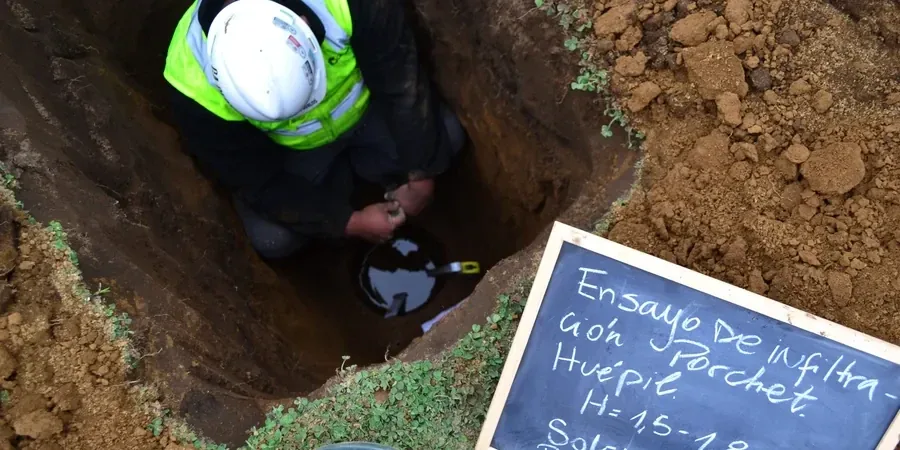
Illustrative image of Infiltration test (Porchet/Double-ring infiltrometer) in Sydney
A double-ring infiltrometer isolates vertical flow from lateral spreading, critical for accurate soakage design in layered Sydney soils.

Our service areas

Scope of work

The coastal humidity in Sydney can saturate near-surface soils even after short rain events, skewing field infiltration readings if tests are performed too soon. We time our infiltration tests to represent the driest realistic condition, as required by most council stormwater guidelines. Each test involves controlled flooding of a concentric ring system, recording falling head over time until steady-state flow is reached. In areas like the Cumberland Plain, where dispersive soils are common, we also recommend a complementary subgrade CBR evaluation to assess the subgrade’s response to prolonged wetting.
  • Porchet method for shallow soakage pits (0.5–2.0 m depth)
  • Double-ring infiltrometer for surface permeability (0–0.5 m)
  • Continuous data logging with automatic water-level sensors
  • Reporting in accordance with AS 4678 for earth-retaining structures and drainage
Technical reference — Sydney

Area-specific notes

A common pitfall in Sydney is relying on a single infiltration test near the surface. Shale-derived clays in the west can show high initial infiltration that drops sharply once the soil swells. Our field crew uses a double-ring infiltrometer with a constant head reservoir, monitoring the rate over at least 90 minutes. If the rate does not stabilize, we extend the test to 4 hours. This avoids under-designed soakage pits that fail within the first wet season.

Need a geotechnical assessment?

Reply within 24h.

Email: contact@geotechnicalengineering1.co

Standards used

AS 1726 – Geotechnical Site Investigations, AS 4678 – Earth-Retaining Structures, AS 1289 – Standard Test Method for Infiltration Rate of Soils in Field Using Double-Ring Infiltrometer

Technical parameters

ParameterTypical value
Test depth range0.3 – 3.0 m
Ring diameter (single)300 mm
Ring diameter (double)300 mm inner / 600 mm outer
Falling head intervalEvery 10 min for 2 hours or until steady state
Hydraulic conductivity range10⁻⁶ – 10⁻² m/s

Quick answers

How long does a typical double-ring infiltrometer test take in Sydney?

A standard test takes 2–3 hours per location. If the soil is clayey (common in western Sydney), we extend the test to 4 hours to confirm steady-state flow. Automated logging can run overnight for low-permeability sites.

Do I need council approval for infiltration testing in Sydney?

Most Sydney councils require infiltration testing for stormwater disposal systems under their DCPs. We provide a report that includes field data, hydraulic conductivity values, and compliance with AS 4678, which councils accept for BASIX and drainage approvals.

How much does an infiltration test cost in Sydney?

Our rates range from AU$460 to AU$730 per test location, depending on depth, ring configuration, and reporting requirements. Volume discounts apply for multiple test pits on the same site.

Location and service area

We serve projects across Sydney and its metropolitan area.

View larger map