SYDNY
SYDNEY
HomeFoundationsSeismic Foundation Design

Seismic Foundation Design in Sydney

Rigorous testing. Clear reporting.

LEARN MORE

Our team deploys a 20-tonne track-mounted drill rig equipped with automatic SPT hammers and a down-hole seismic source for Vs30 profiling across Sydney. The rig cuts through Hawkesbury Sandstone and the alluvial clays of the Parramatta River corridor, reaching depths of 30 to 40 metres in a single shift. This setup allows us to retrieve undisturbed samples and run cross-hole tomography when the project demands high-resolution shear-wave velocity data for seismic foundation design. The equipment is calibrated to AS 1289 and the NEHRP site classification system, ensuring that every velocity profile we produce is directly usable for the AS 1170.4 response spectrum.
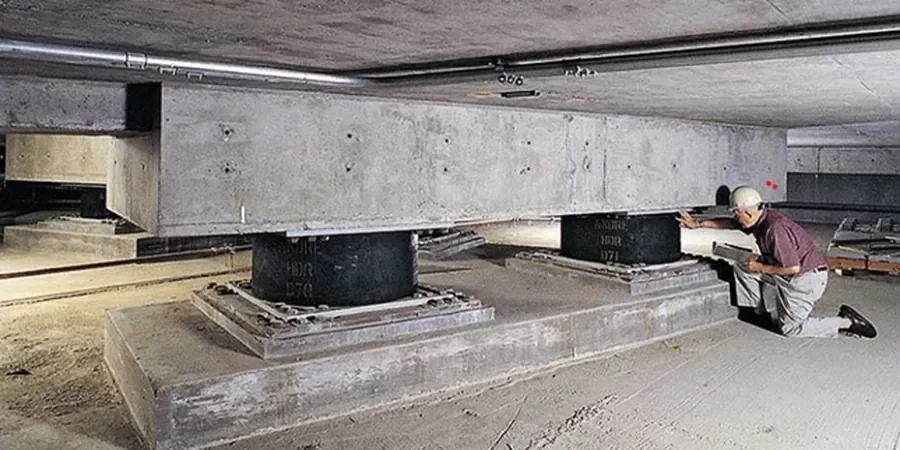
Illustrative image of Seismic foundation design in Sydney
A site on Hawkesbury Sandstone may qualify as Class Bc while fill in Homebush Bay can drop to Class De — a six-fold difference in spectral acceleration.

Our service areas

Scope of work

The Sydney Basin presents a contrast between the stiff Hawkesbury Sandstone that underlies the CBD and the deep Quaternary alluvium of the Cooks River and Georges River valleys. A site on sandstone may qualify as Class Bc (rock), while a site in Homebush Bay fill can drop to Class De (deep soft soil) — a six-fold difference in spectral acceleration. For projects straddling this transition, we combine seismic foundation design with MASW profiling to map the bedrock interface, and we cross-check bearing capacity using plate load tests on the actual founding material. This dual approach prevents over-design in rock and under-design in soft ground, which is critical when the design spectrum changes abruptly across a single property boundary.

Technical reference — Sydney

Area-specific notes

Sydney expanded rapidly during the 1880s land boom and again after World War II, with large areas of the Botany Sands and the Cooks River floodplain filled without engineered compaction. These uncontrolled fills, combined with a shallow water table at 1–3 m depth, create a liquefaction hazard under the design earthquake shaking prescribed by AS 1170.4. For a warehouse development near the former Alexandria landfill, our seismic foundation design identified a 2 m thick layer of loose silty sand (N₁₆₀ = 8 blows/ft) that needed ground improvement before spread footings could be used. The client chose vibro-replacement stone columns to densify the layer and reduce the settlement differential to under 15 mm.

Need a geotechnical assessment?

Reply within 24h.

Email: contact@geotechnicalengineering1.co

Standards used

AS 1170.4:2007 (Earthquake actions in Australia), AS 1726:2017 (Geotechnical site investigations), NCEER 1997/2001 (SPT-based liquefaction trigger curves)

Technical parameters

ParameterTypical value
Vs30 (shear-wave velocity top 30 m)180 – 1.500 m/s depending on geology
Site class per AS 1170.4Ae (rock) to Ee (very soft soil)
Design PGA (0,5s period, 1/500 yr)0,08 g (Class Be) to 0,28 g (Class De)
Liquefaction trigger threshold (NCEER)N₁₆₀ < 30 blows/ft in Holocene sands
Allowable bearing pressure (serviceability)150 kPa (soft clay) to 3.000 kPa (fresh sandstone)
Seismic gap / separation joint width25 – 75 mm per AS 1170.4 clause 6.3

Quick answers

When do I need a formal seismic foundation design for a building in Sydney?

According to AS 1170.4, any Importance Level 2 or higher building — which covers most commercial, multi-residential, and institutional structures — must consider seismic actions. A formal seismic foundation design is required when the site class is De or Ee, when the building period exceeds 0.5 s, or when the design PGA at the site exceeds 0.10 g. For a typical three-storey office on Class Be rock, the code may not require a full dynamic analysis, but we still recommend a simplified check for overturning and sliding.

What is the difference between a site-specific response spectrum and the standard AS 1170.4 spectrum?

The standard AS 1170.4 spectrum uses generic shape factors that are conservative for most sites. A site-specific spectrum, derived from Vs30 measurements and a local seismic hazard model, can reduce the design base shear by 15–35% on stiff rock sites and increase it on soft soil sites where the code underestimates amplification.

How do you determine the site class for seismic foundation design?

We determine site class by measuring the average shear-wave velocity in the top 30 metres (Vs30) using a combination of MASW and down-hole seismic testing. The result is compared against the AS 1170.4 Table 4.1 boundaries: Class Ae (Vs30 > 1.500 m/s), Be (760–1.500 m/s), Ce (360–760 m/s), De (180–360 m/s), and Ee (Vs30 < 180 m/s). In the Botany Sands area, we typically measure Vs30 between 200 and 280 m/s, which classifies the site as De and triggers the need for a detailed liquefaction assessment.

What is the typical cost range for a seismic foundation design study in Sydney?

For a standard commercial project in Sydney, the cost of a seismic foundation design study — including Vs30 profiling, site classification, and a liquefaction assessment — ranges between AU$1,920 and AU$7,120. The variation depends on the number of boreholes needed, the depth of the seismic array, and whether the site requires additional cross-hole tomography. A simple two-borehole MASW on Class Be rock will be at the lower end, while a six-borehole programme on Class De fill with a deep water table will approach the upper bound.

Location and service area

We serve projects across Sydney and its metropolitan area.

View larger map