SYDNY
SYDNEY
HomeIn-Situ TestingDensidad de campo (cono de arena)

Field Density Test (Sand Cone Method) in Sydney – Quality Control for Earthworks

Rigorous testing. Clear reporting.

LEARN MORE

Sydney's geology presents a particular challenge for compaction control: the transition from Hawkesbury Sandstone residual soils to the shale-derived clays of the Wianamatta Group often creates abrupt changes in fill behaviour. Many project teams in the Sydney basin rely on the sand cone method precisely because it gives a direct, in-place measurement of dry density and moisture content without the assumptions of nuclear gauges. Before mobilising compaction equipment on a deep fill zone, it is common practice to run a placa de carga test on the prepared subgrade to correlate bearing capacity with the density values obtained from the sand cone. This two-step approach helps engineers decide whether to approve the layer or request additional passes.
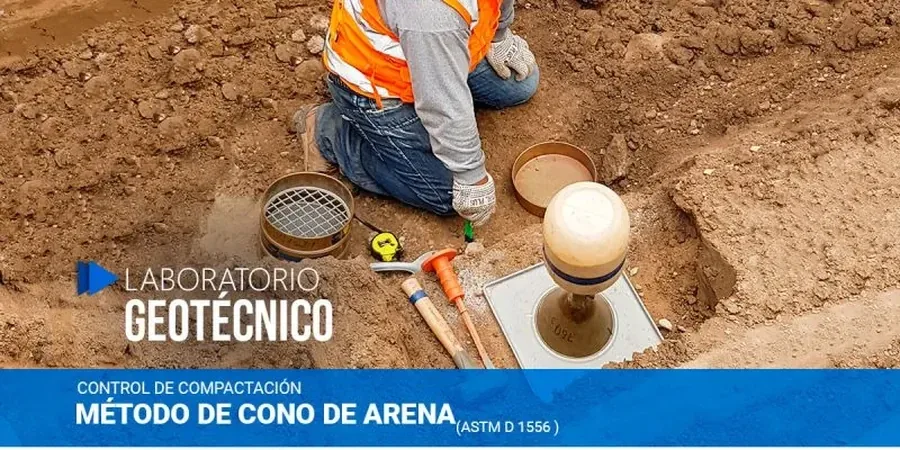
Illustrative image of Field density test (sand cone method) in Sydney
The sand cone method remains the referee test for compaction disputes in Sydney because it measures actual soil density without relying on radioactive sources or empirical correlations.

Our service areas

Scope of work

A recurring mistake among contractors new to Sydney's northern suburbs is assuming that a single Proctor reference curve applies across the entire site. The sand cone method exposes this error by sampling each lift individually and comparing the result against the laboratory compaction curve for that specific material. The procedure itself is straightforward: a small test hole is dug, the excavated soil is weighed and dried, and the volume of the hole is determined by filling it with calibrated sand from a cone apparatus. The test follows AS 1289.5.3.1, which specifies the sand grading and cone dimensions. Experienced technicians know that the sand's flow characteristics change with humidity, so they calibrate the apparatus on site before each series of readings. This level of discipline makes the sand cone test particularly reliable when verifying compaction in utility trenches and road subgrades across Sydney's varied terrain.
Technical reference — Sydney

Area-specific notes

The rapid suburban expansion of Sydney's north-west growth corridor has placed enormous pressure on earthworks quality control. Developments in areas like Box Hill and Marsden Park have seen fill thicknesses exceeding 6 metres in former creek valleys. When field density tests using the sand cone method are skipped or performed too infrequently, the result is differential settlement that cracks pavements, distorts kerb lines and damages buried services. The cost of repairing a single street section affected by poorly compacted fill can easily exceed the budget of an entire testing program. This is why councils across Greater Sydney now mandate minimum testing frequencies in their engineering specifications.

Need a geotechnical assessment?

Reply within 24h.

Email: contact@geotechnicalengineering1.co

Standards used

AS 1289.5.3.1 – Determination of field dry density using sand replacement method, AS 1289.5.1.1 – Compaction control test (Hilf method), AS 1289.2.1.1 – Soil moisture content determination (oven-drying method)

Technical parameters

ParameterTypical value
Test standardAS 1289.5.3.1
Test hole diameter100 mm to 200 mm
Maximum particle size50 mm (coarser requires correction)
Sand density calibrationPerformed on-site before each test series
Reporting unitsDry density (t/m³) and degree of compaction (%)
Moisture determinationOven-dry method per AS 1289.2.1.1

Quick answers

How many sand cone tests are typically required per lot in a Sydney subdivision?

Council specifications in Sydney's growth areas typically require one sand cone test per 500 m² of fill area per lift, with a minimum of three tests per structural fill zone. Trench backfill compaction is usually tested every 200 linear metres or at each change in material type.

Can the sand cone method be used on wet or saturated fills?

The reference range for this service in Sydney is AU$150 - AU$210. The final price depends on the project scope and volume.

What is the typical price range for a sand cone field density test in Sydney?

For a standard sand cone test including on-site execution, laboratory moisture determination and a certified result, the typical cost ranges between AU$150 and AU$210 per test. Bulk rates for projects requiring 20 or more tests often reduce the per-test cost.

Does the sand cone test work on granular fills like crushed sandstone?

It works well on well-graded granular fills with particles up to 50 mm. For coarser fills such as rock armour or large-diameter crushed sandstone, alternative methods like the nuclear gauge or the water replacement method (AS 1289.5.3.5) are more appropriate. Our technicians assess the material on site and recommend the correct test method.

Location and service area

We serve projects across Sydney and its metropolitan area.

View larger map