SYDNY
SYDNEY
HomeSlopes & WallsSlope Failure Analysis

Slope Failure Analysis in Sydney – Geotechnical Assessment by NATA-Accredited Laboratory

Rigorous testing. Clear reporting.

LEARN MORE

The combination of Sydney’s coastal humidity and the deeply weathered Hawkesbury Sandstone creates a unique challenge for slope failure analysis. Moisture infiltration from frequent summer storms reduces suction in the unsaturated zone, triggering progressive strength loss along pre-existing joints. Our team performs field mapping and laboratory testing to characterise these conditions, using the unsaturated shear strength framework from Fredlund & Rahardja. For sites where seepage is a concern, we integrate data from a permeability test to quantify hydraulic conductivity. This approach ensures that the failure mechanism is correctly identified before any numerical modelling begins.
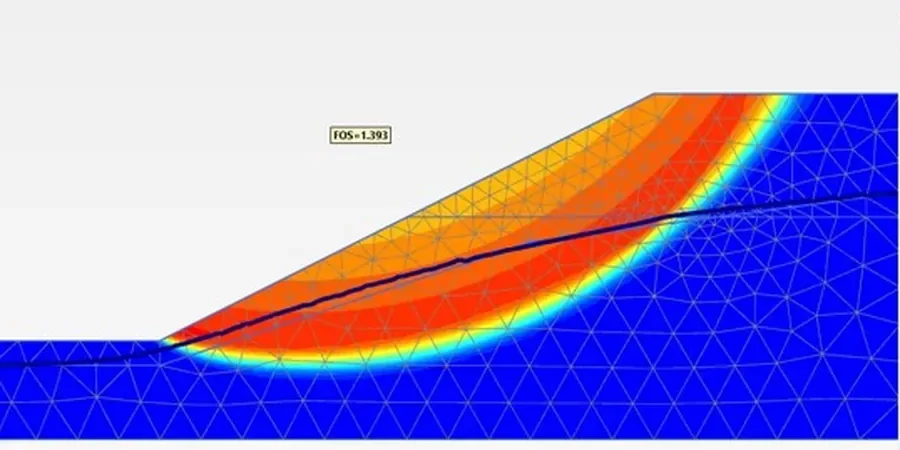
Illustrative image of Slope failure analysis in Sydney
Moisture-driven loss of suction in Hawkesbury Sandstone is the primary trigger for shallow slope failures in Sydney.

Our service areas

Scope of work

We mobilise a track-mounted core drill for undisturbed sampling in the sandstone cap and the underlying Ashfield Shale. The rig reaches depths of 15 to 25 metres, which is sufficient to intersect the critical failure surface in most Sydney slopes. Samples are sealed on-site and transported to our laboratory within 24 hours. There we run direct shear and triaxial tests under saturated and unsaturated conditions, following AS 1289.6.2.2 and AS 1289.6.4.2. When the failure plane is controlled by bedding or foliation, we also perform tilt tests on intact joints. A classification of soils according to the Unified System helps correlate the geotechnical units across the site. The combination of field data and laboratory results feeds directly into limit equilibrium software using the Morgenstern-Price method.
Technical reference — Sydney

Area-specific notes

AS 4678-2002 (Earth Retaining Structures) is the governing standard for slope failure analysis in Sydney, but its application depends heavily on the assumed failure mechanism. In the northern suburbs, where the Narrabeen Group mudstones are prevalent, the risk is toppling or planar sliding along bedding planes dipping toward the excavation. Our analysis explicitly checks for these kinematic modes using stereographic projection. We also consider the impact of construction vibration on sensitive joints, a factor often overlooked in standard limit equilibrium. By combining kinematic analysis with strength testing, we provide a factor of safety that reflects the actual failure mode, not a generic circular slip surface.

Need a geotechnical assessment?

Reply within 24h.

Email: contact@geotechnicalengineering1.co

Standards used

AS 4678-2002 – Earth Retaining Structures, AS 1726-2017 – Geotechnical Site Investigations, AS 1289.6.2.2 – Direct Shear Test of Soils, FHWA-NHI-10-033 – Slope Stability Reference Manual

Technical parameters

ParameterTypical value
Cohesion intercept (c')5 – 30 kPa
Friction angle (phi')28 – 42 degrees
Unsaturated shear strength (phi^b)12 – 18 degrees
Factor of safety (target)≥ 1.5 (static), ≥ 1.1 (seismic)
Groundwater depth2 – 8 m below surface
Sample recovery ratio> 85% in shale, > 70% in sandstone

Quick answers

What is the difference between limit equilibrium and finite element methods for slope failure analysis?

Limit equilibrium methods such as Spencer or Morgenstern-Price assume a predefined failure surface and calculate the factor of safety by balancing driving and resisting forces. Finite element methods, like those in PLAXIS, model stress-strain behaviour and can capture progressive failure and deformation. For Sydney slopes with complex jointing, limit equilibrium is often preferred because it is faster and more transparent for code compliance, while FEM is used when post-peak strength loss or soil-structure interaction matters.

How much does a slope failure analysis cost in Sydney?

The cost for a slope failure analysis in the Sydney region typically ranges between AU$1.480 and AU$4.260, depending on the number of boreholes, laboratory tests required and the complexity of the failure mechanism. A basic assessment for a single cut slope may fall at the lower end, while a detailed analysis with unsaturated triaxial testing and kinematic modelling reaches the upper bound.

Which slopes in Sydney are most prone to failure?

Slopes cut into the Ashfield Shale along the M2 and M4 corridors are historically prone to planar sliding along bedding planes, especially where the shale is weathered to a clay. In the northern beaches area, colluvium over Hawkesbury Sandstone often fails as shallow translational slides after prolonged rain. Any slope steeper than 25 degrees with a south-facing aspect retains more moisture and presents higher risk.

Do you provide instrumentation recommendations as part of the analysis?

Yes. We specify standpipes for pore pressure monitoring, inclinometers to measure lateral movement and surface markers for crack monitoring. The number and location of instruments are based on the critical failure surface identified in the limit equilibrium model. We also provide threshold movement rates that trigger a review of the slope condition.

Location and service area

We serve projects across Sydney and its metropolitan area.

View larger map