SYDNY
SYDNEY
HomeLaboratoryCaracterización de suelos residuales

Residual Soil Characterization in Sydney

Rigorous testing. Clear reporting.

LEARN MORE

A 20-story residential tower near Parramatta required foundation design on deeply weathered Hawkesbury Sandstone. The original borehole logs showed low SPT N-values in the upper 8 meters, typical of residual soil profiles in western Sydney. Our team extracted undisturbed block samples from test pits to measure the intact fabric and matrix suction. We then correlated these results with the placa de carga modulus to define the allowable bearing pressure. The client avoided over-design by using site-specific parameters instead of conservative literature values.
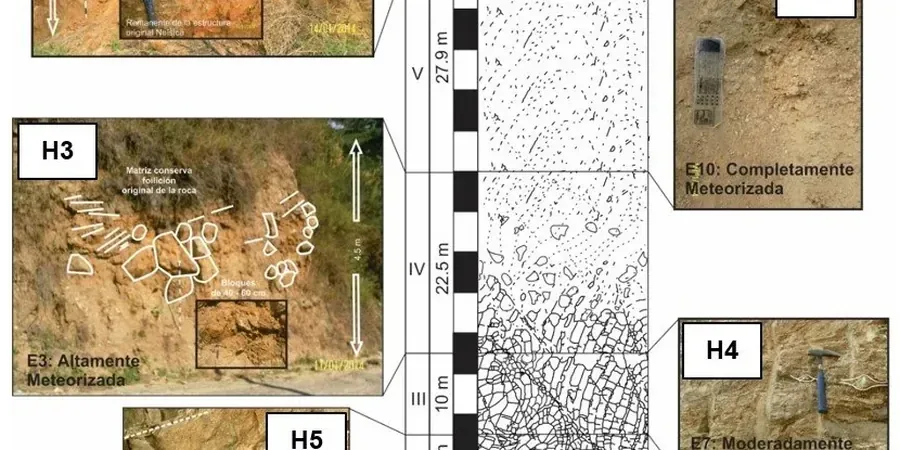
Illustrative image of Residual soil characterization in Sydney
Residual soils in Sydney retain the relic fabric of the parent rock — laboratory tests must preserve that structure to give reliable design parameters.

Our service areas

Scope of work

Sydney's geology is dominated by Triassic sandstone and shale sequences that produce residual soils with a wide range of weathering grades. In the northern suburbs around Hornsby, the shale-derived clays exhibit high plasticity and shrink-swell potential. For deeper profiles, the ensayo SPT provides a rapid index of strength, but it often underestimates the stiffness of structured residual soils. Laboratory characterization must include:
  • Undrained triaxial tests on undisturbed samples (UU and CIU)
  • Atterberg limits and linear shrinkage on the fine fraction
  • Moisture content and density profiles from core samples
  • X-ray diffraction for clay mineral identification in problem soils
These tests help distinguish between true residual soil and transported colluvium, which behave very differently under load.
Technical reference — Sydney

Area-specific notes

In Sydney, many engineers assume residual soils behave like transported fills. That assumption leads to settlement problems. We regularly see structures on weathered shale in the Ryde area that settled 30–50 mm more than predicted because the laboratory used remolded samples. The risk is real: residual soil fabric collapses when the matrix suction is lost during excavation or prolonged wet periods. Our approach includes suction measurements and wetting-induced collapse tests to quantify this behavior before construction starts.

Need a geotechnical assessment?

Reply within 24h.

Email: contact@geotechnicalengineering1.co

Watch how it works

Standards used

AS 1726:2017 Geotechnical site investigations, AS 1289.6.3.1 Standard Test Method for SPT, AS 1289.6.4.1 Standard Test Method for UU Triaxial

Technical parameters

ParameterTypical value
Undrained shear strength (su)40–120 kPa (UU test)
Effective cohesion (c')5–20 kPa
Effective friction angle (φ')28–38°
Oedometer modulus (Eoed)8–25 MPa
Linear shrinkage5–12% (shale-derived soils)

Quick answers

Why can't I use standard SPT correlations for residual soils in Sydney?

SPT correlations were developed for sedimentary sands and normally consolidated clays. Residual soils have a structured fabric and often exhibit higher stiffness at low strains than SPT N-values suggest. You need laboratory moduli from triaxial or oedometer tests on undisturbed samples to get realistic settlement estimates.

How much does residual soil characterization cost for a typical Sydney residential project?

For a standard house site with 2 test pits and 5 laboratory tests, the cost ranges from AU$1,180 to AU$5,560 depending on the number of triaxial tests and mineralogy work. Larger commercial sites with multiple boreholes fall at the upper end of that range.

What is the difference between residual soil and colluvium in Sydney?

Residual soil is weathered in place and retains the parent rock fabric and structure. Colluvium has been transported downslope by gravity — it has no relic fabric, and its particle arrangement is random. The two materials have very different strength and compressibility. A careful field description plus thin-section analysis in the lab can distinguish them.

Which zones of Sydney have the highest residual soil risk?

The shale-derived residual soils in the northern suburbs — Chatswood, Lindfield, Hornsby — have moderate to high shrink-swell potential. In the west, around Penrith, the clayey sands from weathered sandstone can collapse when wetted. Each zone requires a tailored laboratory program.

How long does a complete characterization take?

Block sampling and field work take 1–2 days. Laboratory testing — including triaxial, oedometer, and suction tests — typically takes 3 to 4 weeks. Mineralogy results (XRD) add about 10 working days. We coordinate with your project schedule to prioritize critical tests first.

Location and service area

We serve projects across Sydney and its metropolitan area.

View larger map