SYDNY
SYDNEY
HomeGround improvementPreloading Design Without Surcharge

Preloading Design Without Surcharge in Sydney

Rigorous testing. Clear reporting.

LEARN MORE

Too many contractors in Sydney underestimate the settlement that soft alluvial clays and estuarine deposits will undergo under fill loads. They assume standard compaction is enough, then watch floor slabs crack and pavements dip months later. Preloading design without surcharge addresses this directly by placing a controlled fill load over the site long enough to drive out pore water and achieve primary consolidation. For Sydney sites overlying the Botany Sands aquifer or the Hawkesbury Sandstone valleys, this approach avoids the need for temporary surcharge materials that often complicate logistics in tight urban blocks. Combining this with a proper study of consolidation ensures the settlement timeline matches your construction schedule without surprises.
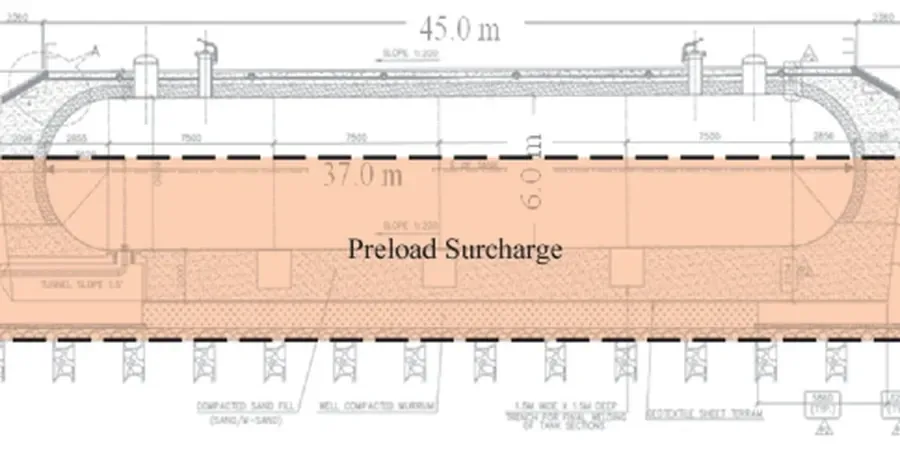
Illustrative image of Preloading design (without surcharge) in Sydney
Without proper preloading design, soft Sydney clays can settle 200 to 400 mm under fill, cracking slabs and breaking underground services.

Our service areas

Scope of work

A typical project in Sydney's inner west involved a 14-storey residential tower on 8 metres of soft clay over sandstone. The geotechnical team specified a preloading design without surcharge using 5 metres of granular fill placed in three stages over 14 weeks. Settlement plates and piezometers tracked pore pressure dissipation daily. Key aspects of the design include:
  • Fill height calculated to match the final building load without exceeding bearing capacity of the underlying clay.
  • Monitoring period defined by 90% consolidation, typically 3 to 6 months depending on clay layer thickness.
  • Drainage paths improved with vertical wick drains or sand drains where permeability is low.
In parallel we often run plate load tests on the preloaded surface to confirm the modulus of subgrade reaction before foundation construction begins. This gives the structural engineer hard numbers for slab design.
Technical reference — Sydney

Area-specific notes

The main risk with preloading design without surcharge in Sydney is misjudging the consolidation coefficient of the estuarine clays found along the Parramatta River corridor and in the Cooks River catchment. If the coefficient is overestimated, the preload period becomes too short and residual settlement exceeds the design tolerance. We use oedometer tests on undisturbed samples to measure Cv at in-situ stress levels. Our laboratory holds ISO 17025 accreditation for AS 1289.6.6.1 consolidation testing, so the data is defensible in design reviews. We also cross-check with field dissipation tests from CPTu soundings to validate the lab results before finalising the preload schedule.

Need a geotechnical assessment?

Reply within 24h.

Email: contact@geotechnicalengineering1.co

Standards used

AS 1726:2017 Geotechnical site investigations, AS 1289.6.6.1 Standard test method for one-dimensional consolidation properties of soils, AS 4678-2002 Earth retaining structures (referenced for fill stability)

Technical parameters

ParameterTypical value
Fill height (typical)3 to 6 m
Consolidation time target90% primary consolidation
Monitoring instrumentsSettlement plates, piezometers, inclinometers
Acceptable post-construction settlement< 25 mm for structures
Drainage improvementWick drains at 1.5 to 2.5 m spacing
Fill materialGranular, compacted to 95% MDD

Quick answers

How long does a preloading design without surcharge typically take in Sydney?

For most sites in Sydney with clay layers 5 to 10 m thick, the preload period runs between 12 and 24 weeks to reach 90% consolidation. The exact duration depends on the coefficient of consolidation and the drainage path length. We provide a site-specific schedule after lab testing.

What is the typical cost range for a preloading design assessment in Sydney?

A full preloading design including sampling, consolidation testing, and analysis typically costs between AU$1,210 and AU$3,410. The final price depends on the number of boreholes, sample quality, and required monitoring instrumentation.

Can preloading work on very soft clays without surcharge?

Yes, but only if the fill load does not exceed the bearing capacity of the clay. For very soft clays with undrained shear strength below 15 kPa, we recommend staged loading or wick drains to accelerate dissipation. Without surcharge, the preload height is limited by stability.

What monitoring is required during the preload period?

We install settlement plates at the base of the fill, piezometers at multiple depths, and occasionally inclinometers near slope edges. Readings are taken weekly during rapid fill placement and bi-weekly during the holding period. The data validates the consolidation model and confirms when to remove the preload.

Location and service area

We serve projects across Sydney and its metropolitan area.

View larger map