SYDNY
SYDNEY
HomeGround improvementVibrocompaction Design

Vibrocompaction Design in Sydney

Rigorous testing. Clear reporting.

LEARN MORE

Sydney's coastal geology presents a specific challenge: nearly 35% of the metropolitan area sits on unconsolidated Quaternary sands, particularly in the Botany Sands region stretching from the airport to La Perouse. These loose to medium-dense sands, often water-saturated below 3 meters, demand ground improvement before medium to heavy structures can be safely founded. Vibrocompaction design in Sydney directly addresses this — it densifies granular soils through depth vibrators, reducing settlement risk and increasing bearing capacity without excavating or replacing material. The method is especially relevant given the city's moderate seismicity (AS 1170.4 design spectrum) where loose sands can liquefy under cyclic loading. Before specifying vibrocompaction parameters, geotechnical teams typically run a dilatometer test to profile lateral stress and density distribution across the site.
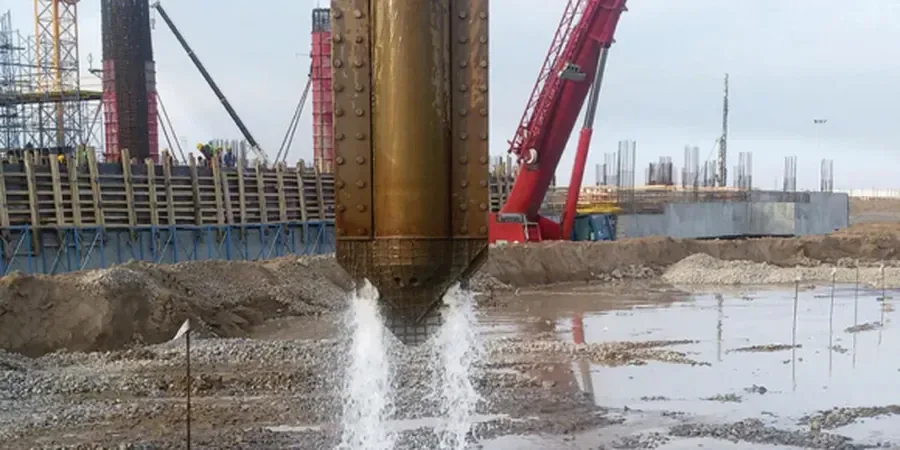
Illustrative image of Vibrocompaction design in Sydney
Target relative density of 70-75% post-treatment yields allowable bearing pressures of 250-350 kPa in Sydney's loose sands.

Our service areas

Scope of work

AS 1726 establishes the site investigation framework, but vibrocompaction design in Sydney follows the execution guidelines of AS 4678 for earth retaining structures and the broader ground improvement principles of Eurocode 7 Part 1 (EN 1997-1). The design relies on three input parameters: relative density (Dr), fines content below 15%, and groundwater depth. For a typical site in Zetland or Green Square, the target relative density after treatment is 70-75% to achieve allowable bearing pressures of 250-350 kPa. The probe penetration resistance ratio (N1,60 after correction) must increase from an initial 5-10 blows per 0.3 m to a post-treatment 15-20 blows. We use the empirical relationships from Schmertmann (1978) and the updated DBYD guidelines for utility clearance before probe insertion. Grid spacing is determined by the vibrator power: a 100-150 kW probe achieves 3-4 m spacing in clean sand, tighter in silty zones.
Technical reference — Sydney

Area-specific notes

The deep vibrator assembly — a 6-8 tonne eccentric mass rotating at 1,800-3,000 rpm — generates horizontal vibrations that propagate radially through the sand matrix. In Sydney's urban infill sites, this poses two risks: damage to adjacent underground services and nuisance vibration to nearby structures. The probe typically operates with a tip amplitude of 10-20 mm and creates a compaction radius of 2-3 m per insertion point. We pre-survey all utilities within 10 m of the treatment zone using GPR and potholing. For sites near heritage sandstone buildings in The Rocks or Surry Hills, we limit vibration velocity at foundation level to 5 mm/s peak particle velocity, per DIN 4150-3 recommendations. Continuous monitoring with triaxial geophones is mandatory for those cases.

Need a geotechnical assessment?

Reply within 24h.

Email: contact@geotechnicalengineering1.co

Standards used

AS 1726:2017 (Geotechnical site investigations), AS 4678:2002 (Earth retaining structures), Eurocode 7 – EN 1997-1:2004, DIN 4150-3 (Structural vibration limits)

Technical parameters

ParameterTypical value
Initial relative density (Dr)30-45%
Target N1,60 (post-treatment)15-20 blows/0.3m
Vibrator power range100-200 kW
Typical probe spacing (clean sand)3.0-4.0 m
Maximum treatment depth25-30 m
Fines content limit< 15% passing 75 μm

Quick answers

How does vibrocompaction differ from dynamic compaction?

Vibrocompaction uses a deep probe that vibrates horizontally to densify loose sands from the bottom up, typically reaching depths of 25-30 m. Dynamic compaction uses a heavy drop weight (10-20 tonnes) from height, which densifies the upper 6-10 m. Vibrocompaction is preferred for deeper treatment in saturated sands and for sites with nearby structures where the impact of dynamic compaction would cause excessive vibration.

What is the typical cost range for vibrocompaction design in Sydney?

For a standard residential or commercial site in Sydney, the design and QA component ranges between AU$1,980 and AU$7,890 depending on site area, number of probe locations, and reporting requirements. This does not include the contractor's execution costs, which vary with probe depth and mobilisation.

Can vibrocompaction be used in sands with fines above 15%?

Effectiveness drops significantly when fines (silt and clay particles) exceed 15-20% by weight. In those cases, stone columns (vibro-replacement) are more appropriate because the granular backfill provides drainage and reinforcement. A site-specific trial is recommended if fines content sits between 15% and 25%. Our design includes a boundary assessment to recommend the correct ground improvement method.

Location and service area

We serve projects across Sydney and its metropolitan area.

View larger map