SYDNY
SYDNEY
HomeSlopes & WallsExpert Slope Stabilization Design

Expert Slope Stabilization Design in Sydney

Rigorous testing. Clear reporting.

LEARN MORE

Sydney's topography is dominated by Hawkesbury Sandstone overlain by clay-rich soils from the Wianamatta Group. These units create challenging conditions for hillside developments, especially in suburbs like North Sydney, Wahroonga, and the Northern Beaches. Groundwater seepage along bedding planes often reduces effective stress, triggering planar failures in cut slopes. Our team combines kinematic analysis with limit equilibrium methods to design stabilization solutions that respect local geology. Before starting slope remediation, we often recommend a georeferenced GPR survey to map subsurface fractures and a drainage geotechnical assessment to control water pressure. This approach ensures designs are solid and cost-effective for Sydney's variable terrain.
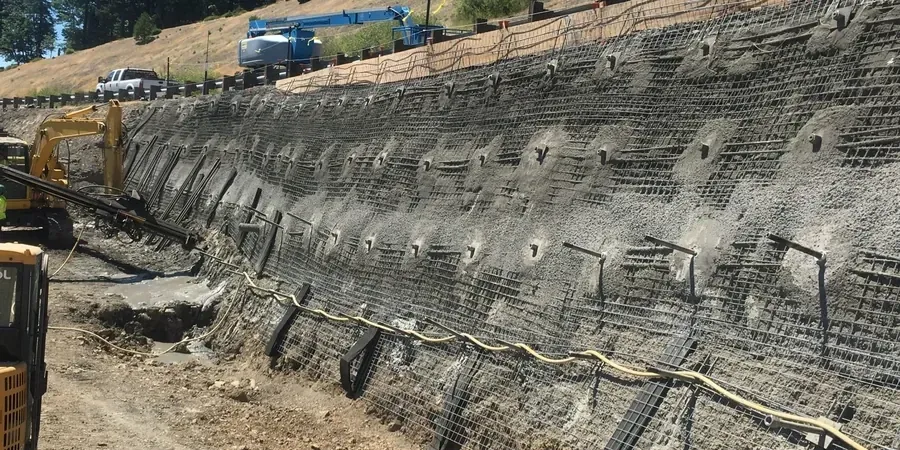
Illustrative image of Slope stabilization design in Sydney
A slope that looks stable after dry weather can fail catastrophically when a storm saturates the Hawkesbury Sandstone joints — our designs account for that.

Our service areas

Scope of work

Urban expansion in Sydney has pushed developments onto steep terrain that was historically avoided. Suburbs like Castle Hill and Pennant Hills now feature housing estates carved into residual soil profiles where the original slope stability was compromised during earthworks. Our slope stabilization design process follows AS 4678-2002 and incorporates site-specific parameters from in-situ testing. We use a combination of drilled soil nails, shotcrete facing, and subsurface drainage to achieve target factors of safety typically between 1.3 and 1.5 for static conditions.
  • We install vibrating-wire piezometers to monitor pore pressures continuously.
  • We design weep holes and horizontal drains to relieve hydrostatic loads.
  • We model long-term creep using residual shear strengths from ring shear tests.
This integrated method has been applied on dozens of Sydney projects where the margin between stable and failed slopes is narrow.
Technical reference — Sydney

Area-specific notes

The most common failure mechanism we see in Sydney slopes is a translational slide along a sandstone bedding plane, often triggered by excavation that undercuts the toe. In areas like Frenchs Forest and Wheeler Heights, the colluvium mantle can be up to 4 meters thick and becomes unstable when saturated. We use a combination of inclinometers and survey prisms to monitor movement in real time during construction. If displacement exceeds 5 mm in a day, we halt work and adjust the stabilization design immediately. This level of monitoring is not optional on critical slopes — it is a contractual requirement under AS 4678.

Need a geotechnical assessment?

Reply within 24h.

Email: contact@geotechnicalengineering1.co

Watch how it works

Standards used

AS 4678-2002: Earth Retaining Structures, AS 1726-2017: Geotechnical Site Investigations, AS/NZS 1170.2: Wind Actions (for surface erosion)

Technical parameters

ParameterTypical value
Target factor of safety (static)1.30 - 1.50
Target factor of safety (seismic)1.10 - 1.20
Maximum nail inclination15° - 20° from horizontal
Drain spacing (horizontal drains)3.0 m - 5.0 m centers
Shotcrete thickness100 mm - 150 mm wire-reinforced
Nail bond stress (sandstone)100 kPa - 200 kPa

Quick answers

What is the typical cost for a slope stabilization design in Sydney?

Depending on site complexity and investigation depth, a complete design package — including drilling, testing, modeling, and reporting — ranges between AU$2,930 and AU$10,740. Large or high-risk slopes at the upper end of this range.

How long does a slope stabilization design take from start to finish?

For a standard residential lot in Sydney's sandstone terrain, we usually complete the investigation and design within 4 to 6 weeks. Complex sites with deep colluvium or high water tables may take 8 to 10 weeks.

What triggers the need for a slope stabilization design in Sydney?

Any development within 10 meters of a slope steeper than 1V:3H typically requires a design. Council approval often demands evidence of a factor of safety above 1.3 under worst-case water conditions.

Location and service area

We serve projects across Sydney and its metropolitan area.

View larger map